


A for Acceptance: ACT, Mindful Presence, and Our Emotional Life
This is the first post in a series where I explore ACT – Acceptance and Commitment Therapy – in a curious and accessible way. My hope is to spark interest and share what I’m learning myself, rather than present myself as an expert.

Photo: Where are you headed? On a path that you chose? or someone else?
Why do emotions grow stronger when we push them away?
This is a question many of us carry, and one that ACT offers a clear and human way of understanding.
When we don’t want to accept the things that disturb or unsettle us, an inner tension begins to build. Thoughts and feelings we try to push away act a bit like a beach ball held underwater. The harder we press it down, the more pressure builds up. And when our grip eventually slips, everything comes rushing up—fast and forcefully. Not because the feeling is more dangerous, but because it finally gets to move freely.
It is often this sudden intensity that scares us. So we do the most human thing there is: we avoid, control, and try to push away what feels difficult, even though it often leads to more stress and distress in the long run.
What does acceptance mean in ACT?
In Acceptance and Commitment Therapy (ACT) – a newer therapeutic approach within the broader field of cognitive-behavioural therapy – this is one of the core principles: our struggle with inner experience often creates more suffering than the experience itself. Here, ACT and Buddhist psychology meet in a shared understanding of human life:
What we fight against grows stronger.
What we allow is given the chance to soften.
When we experience worry, pain, sadness, or self-doubt, we often want to get rid of the discomfort as quickly as possible. We distract ourselves. We tense up. We analyse and ruminate. We try to control what feels uncontrollable. This is natural—but rarely brings the relief we hope for.
In both ACT and Buddhist psychology, suffering is seen as something that grows when we resist reality. Acceptance doesn’t mean giving up—it means allowing what is already here to exist without using all our energy to fight it. When we give feelings space without battling them, they often become softer, less frightening, and more manageable.
Why emotions can feel stronger when we push them away
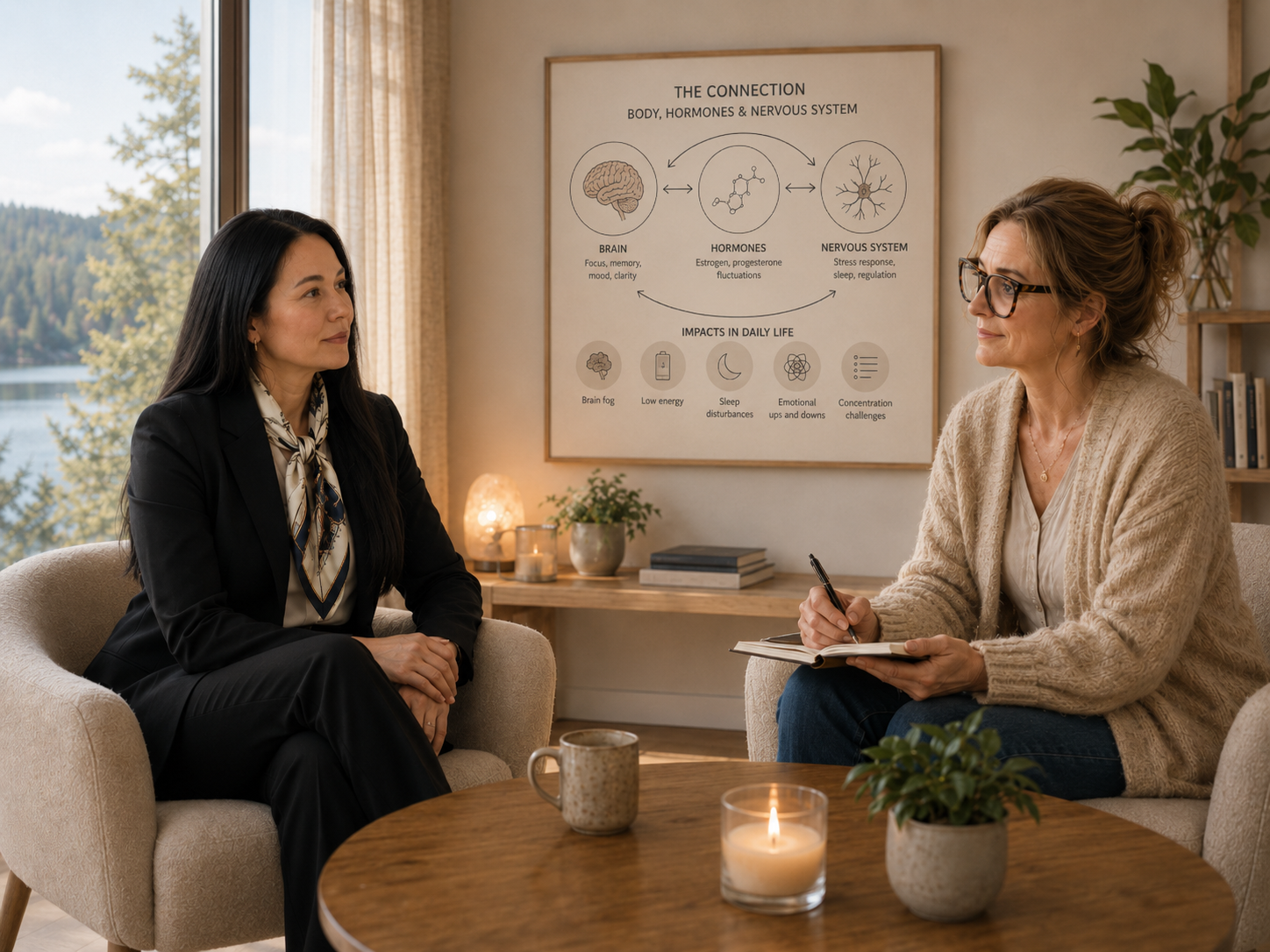
When we fight against our inner experiences, both physical tension and mental effort tend to increase. This activates the sympathetic nervous system — the body’s built-in fight, flight, or freeze response — which can make emotions feel as if they return with even greater intensity. In ACT, we describe this as avoidance strategies amplifying the very discomfort we’re trying to escape. The irony is that our attempts to get away from what feels difficult often highlight the physical and mental reactions even more.
If you want to read more about how I work with ACT and other approaches, you can find more information here.
When the body speaks up
Like so many others, my life changed suddenly when the pandemic began in March 2020. Much of what I had been able to control was suddenly outside my reach. I did what felt safe: I worked more. A lot more. Twelve to fourteen hours a day gave me a sense of control in the moment, but my body couldn’t keep up.
My sleep declined. My adrenaline never settled. My muscles were constantly tense. Everything I tried to hold down pushed back with even greater intensity.
Eventually, it was my body—and my deeper nervous system—that drew the line. When we push ourselves too hard for too long, the body, the brain, and our internal resources try to slow us down, as a way to bring us back into balance.
It wasn’t a sign of weakness—it was a sign of being human. My body held a wisdom I had forgotten to listen to. One of the gifts of growing older and becoming more familiar with my own patterns is that I recognised what was happening and managed to pull the brakes in time.
Acceptance as an active direction
Acceptance in ACT is not the same as passivity or resignation. It is an active, deliberate way of meeting what arises within us. When we stop spending all our energy on holding our experiences down, space is freed up for something else: direction, valued action, and presence.
Acceptance means:
• allowing the feeling to be there without needing to change it in the moment
• opening up to inner experience and being willing to feel what is present
• standing tall with turmoil inside, and still moving in the direction of what matters
When we meet a feeling straight on—without fighting it or running from it—it often becomes softer, less frightening, and more manageable. The feeling can be there, but it no longer dictates our whole life.
Psychological flexibility in everyday life
In ACT, this ability to both feel and move forward is called psychological flexibility. It is about opening up to our inner life while taking steps toward what is meaningful to us.
In the therapy room we meet thoughts and feelings with presence
In my work as a counsellor, we explore together what happens when we stop running from what feels difficult. We practise pausing and noticing what is actually happening in the moment:
Here is worry.
Here is tension.
Here is that old voice telling me I should be more, know more, or manage more.
Presence and awareness in the moment
By observing our inner experiences—without needing to change them—we often create just a little more space. And in that space, it becomes possible to ask:
Who do I want to be in this moment?
What step moves me in the direction of what matters, even with this feeling here?
A meaningful life is not built on the absence of discomfort. It comes from the ability to keep living—side by side with what is difficult.
When we meet ourselves this way, ACT becomes more than a method. It becomes a way of living more truthfully, rather than striving to live perfectly. In openness, presence, and willingness, we often find the deepest possibility for meaning.
If you’re curious about ACT and want to explore whether the approach might be a good fit for you, you’re welcome to book a free 15-minute consultation with me. I can share more about how I work, and you can get a sense of whether we’re a good match as therapist and client.