This is a longer article on psychological flexibility. I have allowed it to take up more space than usual because the concept is so central within modern psychology and ACT.
Feel free to read it when you have the time. Make yourself a cup of tea, lean back, and reflect on the difference between living in the direction of your values and dreams—and gradually drifting off course through avoidant behavioural patterns.
The aim is to show how freedom of choice can be trained step by step. Not by needing to feel differently first, but by beginning to notice what is happening and experimenting with new, more conscious ways of acting.
• • •
When psychological flexibility is low, old patterns take over
Many therapists talk about psychological flexibility—or the lack of it—in different ways. When we lack it, old patterns take over, even when they no longer help. It is the moment when a task, decision, or request may seem reasonable from the outside, but internally feels misaligned with something important in you. It may go against a boundary, a value, a need, or a direction you actually want to stay true to. When discomfort becomes strong, the impulse to avoid can quickly take over. You say yes to avoid conflict, stay quiet to avoid discomfort, postpone a conversation to avoid uncertainty, or do what is expected so you do not have to feel the tension of choosing differently.
In the short term, this can feel like relief. But when avoidance starts to guide your choices, your room for action shrinks. What first looked like an easy way out of discomfort can begin to move you further away from what actually matters. Afterwards, it often becomes more helpful to ask: What was I trying to avoid? What became easier in the short term? And what did it cost me in direction, presence, or connection?
This is where the concept of psychological flexibility becomes relevant. Not as another expectation to remain calm, adaptable, or good at handling life, but as a way of understanding what happens when the body, thoughts, and emotions pull in different directions. Psychological flexibility refers to our ability to stay in contact with what is happening inside us, without automatically being driven by it. We may begin to notice: “Something in me is saying no right now,” without immediately needing to avoid, defend, explain, push ourselves through, or give up. It is not about ignoring the body’s signals, but about being able to listen to them with more nuance.
This blog is about what psychological flexibility actually is, why it is such a central concept in Acceptance and Commitment Therapy, or ACT, and modern psychology, and how the body’s responses, learned patterns in the nervous system, and the brain’s way of predicting the world influence how we think, feel, and act. It also explores what can happen in relationships, family life, and work when we become caught in automatic reactions, and how we can begin to notice what is happening without immediately trying to fix it.
When avoidance starts to guide our choices
Let us begin with what happens when psychological flexibility is lacking. I often tell clients that this can feel as though things become cramped inside you. Thoughts grate against something, breathing rises high in the chest, and something in you resists. This is not necessarily visible from the outside. You may still answer emails, pick up children, go to work, say the right things, and continue functioning. On the inside, your sense of choice may feel as though it is shrinking. You are still functioning, but you increasingly experience being stuck in important parts of your life.
In a simplified way, this can be explained as a thought appearing inside you and immediately taking on the quality of being true. The feeling that follows the thought often begins to steer the direction. The body’s tense response then colours the whole situation, so that everything is interpreted through the internal state. It may sound like new thoughts saying: “I have to get away from here,” “I can’t handle this,” “I have to say yes,” “I must not disappoint anyone,” or “this is going to go wrong.”
In a close relationship, this may show up when your partner asks: “Can you put the children to bed tonight?” or “Can we go to my parents this weekend?” On the surface, it may be an ordinary question. But inside, it can feel as though something contracts immediately, especially if you are already tired, overloaded, or feel that you are often expected to say yes. Instead of being able to answer honestly — “I want to help you, but I don’t have the energy tonight” — you may say yes because it is easier in the moment and avoids a conflict, but afterwards you become quieter. The consequence is not only tiredness, but also a growing distance from the person you may love most. The other person believes everything is okay, while you begin to feel overrun or invisible, even though you were the one who decided to say yes.
It is not strange that we follow these impulses. When something feels strong in the body, it is often experienced as a real demand or necessity. Not as one thought among others, but as reality itself. Psychological flexibility does not mean that we never end up there. The ability lies rather in beginning to notice when it happens. It then becomes possible to notice the difference between an impulse and a choice, between a thought and a direction, between the body’s signal and the whole truth of the situation. Often, this is where something in us begins to soften. It does not mean that the feeling disappears immediately, but that we are no longer completely fused with it.
Psychological flexibility in ACT: changing your relationship to thoughts
In Acceptance and Commitment Therapy, psychological flexibility is a central concept. It refers to our ability to be present with what is happening here and now, while still being able to act in the direction of what matters. It sounds simple, but in practice it is often much more challenging than it appears. For most of us, the problem is not that thoughts exist. The difficulty arises when thoughts are given too much authority. In therapy with clients, I often notice this when a client says, “But it is true!” about statements such as “I am worthless” or “I am not good enough,” even though these are clearly thoughts rather than truths.
“I am going to fail” can feel like a fact. The thought “I should be able to handle more” easily becomes an inner rule. When the mind says “I am too much,” it can almost feel like an identity, not like a phrase passing through awareness. At work, this can become visible in ordinary everyday situations. For example, after a meeting where a colleague says: “I think the report needs to be clearer before we send it on.” If your body is already tense with stress, your brain may quickly translate the comment into “they think I am bad.” It can then become difficult to take in what is actually being said.
You may start defending yourself, over-explaining, becoming short in tone, or stop sharing ideas in the next meeting. The consequence is that the feedback is no longer just about the report. Instead, it becomes a question of worth, belonging, or risk. In working life, psychological flexibility can therefore affect collaboration, creativity, and the ability to receive information without losing contact with yourself.
In ACT, we do not try to win a debate with our thoughts. Instead, we allow them to be there without following them. The point is not to replace difficult thoughts with positive ones, but to change our relationship to them. When you notice yourself getting caught in “I can’t handle this,” a small slowing down may allow you to notice: “I am having the thought that I can’t handle this.” That tiny linguistic shift can create space. The thought remains, but it no longer fills the whole room. It becomes something the mind produces, not an order that must automatically be followed.
Psychological flexibility also means that we can stay in contact with our values. What do I want to stand for here? What small step would bring me closer to what matters, even if it feels uncomfortable? How would I act if fear, doubt, or self-criticism were allowed to come along without deciding everything? This is not about pushing yourself. It is about choosing direction with more presence.
Body and mind: why the reaction happens so quickly
Even though psychological flexibility is often described as something cognitive, much of our reaction begins in the nervous system’s rapid orientation. The body does not always wait for us to understand the situation in words. It registers signals, compares them with previous experiences, and prepares us for action. In the moment, this may show up as an impulse to withdraw, explain ourselves, become silent, take control, or resist. This does not mean that the body always makes an accurate assessment of the situation. But it does try to help us orient: Is this safe? Do I need to protect myself? Can I move closer? Should I withdraw?
When the first orientation happens quickly, it can turn into a more familiar behavioural pattern. In private life, this may show up in an everyday conflict. Your partner says: “We need to talk about how we divide everything at home.” The question may be reasonable, but if your system interprets it as criticism rather than contact, you may move into defence before the conversation has even begun. You might respond sharply: “So you mean I never do enough?” Or you may become silent, cold, or walk away. What began as a rapid bodily orientation then becomes a behaviour that affects the relationship. The other person meets a defence instead of you actually listening, and what could have become a conversation about responsibility and needs becomes a conflict about blame, closeness, and safety.
When bodily activation is strong, nuanced thinking becomes harder. This is not a sign of weakness, but of a system prioritising safety and survival over reflection. That is why it is not always enough to tell yourself: “There is no danger.” Sometimes you understand this cognitively, but the body has not caught up. Then psychological flexibility may begin with something more basic than analysis. Flexibility begins in the moment you stop fighting what is happening inside you. It is not about giving up, but about allowing the experience to be there long enough for new room for action to open.
With practice and awareness, you can begin to notice: “My system is activated right now.” You can take in the room, feel the contact with the chair, the floor, or your breath, without turning it into a performance. The body needs time and repeated experience to perceive that it does not have to act as quickly as the impulse says. In that space, it also becomes clearer how the body’s signals shape our experience of the world. This is also where new behaviours can begin to become possible — sometimes by noticing a stress reaction here and now before you follow it, sometimes by beginning to recognise a familiar pattern and gradually influencing how often, or how automatically, it gets to guide you.
The brain predicts the world: interoception and experience
Modern neuroscience describes the brain as a system that constantly interprets and organises our experiences through parallel processes. Lisa Feldman Barrett has described in an accessible way how the brain creates hypotheses about what is happening, based on previous experiences, context, and the body’s internal signals.
Listen to Lisa Feldman Barrett’s theories here >>
This is where the concept of interoception becomes important. Interoception refers to how the brain perceives and interprets signals from inside the body: heart rate, breathing, tension, temperature, hunger, tiredness, activation, and other bodily shifts. These signals are not just background noise. They influence how the world feels. The same situation can therefore be experienced very differently depending on the body’s state. A short message may feel neutral when we are regulated, but threatening when we are already stressed. Silence may feel restful in one context and like rejection in another. A task that felt possible yesterday may feel impossible today, even if the task itself is the same.
In working life, this can become especially clear when the pace is high. You receive a short message from your manager: “Can we look at the report later today?” or “Come by when you have time.” If you are already tired, keyed up, or unsure of how you are doing, the body may read more into the words than they actually say. The brain may quickly fill in with thoughts such as: “Now something is wrong,” “I have missed something,” or “she is dissatisfied with me.” If the reaction gets to guide you, the rest of the day may be spent ruminating, checking details, rewriting things that were already good enough, or avoiding contact. The consequence is that your energy, decisions, and relationships with colleagues are affected by an interpretation that may never have been checked.
This does not mean that the experience is made up. It is real as an experience. At the same time, it is not always an accurate map of the situation. This is precisely where psychological flexibility becomes important. We can hold two things at once: “This feels like a real threat in my body” and “I do not have to treat the feeling as truth.” This is a gentle form of inner freedom that often frees up energy and creates space for alternative, more meaningful behaviours.
When body and thoughts reinforce each other
For a long time, the brain was viewed as an organ that reacts to stimuli. In such a model, nerve cells would be passive until something happens in the outside world, and only then would the brain become activated. Experiences and learning are, in this perspective, mostly seen as something that adjusts how we react to what happens around us.
Today, we view this differently. Research instead points to the brain being active all the time. It does not wait for something to happen, but continuously tries to predict what is about to happen. Previous experiences are used as a kind of foundation, and new information from the body and the outside world adjusts these predictions. This is where the connection between body and thought becomes important — the so-called body-mind connection, which I have written about before. What we experience in the present is not just a direct reflection of reality, but an interpretation in which the brain weighs together what it already “believes it knows” with what is actually happening right now. The result can be an experience that feels like an obvious truth.
Interoception and the brain’s interpretation of the body
Through interoception, it becomes clear that experience does not arise in two steps, where the body first reacts and thought then interprets. Instead, these processes happen simultaneously, as part of the brain’s continuous attempt to create meaning. The brain uses previous experiences to predict what is happening in the body and the outside world, and these predictions are shaped and adjusted in relation to ongoing bodily signals. This means that what we experience as a “reaction” is already an interpreted whole, where bodily state and meaning arise together.
When the system moves toward threat, the experience may become organised around that. Thoughts, memories, and interpretations that fit a threat-focused state become more available. In shame, things that confirm shame are easily activated, such as memories of previous situations where you felt wrong, or thoughts about what you should have done differently. Also, in worry or stress, something that could actually wait may begin to feel urgent — as if you must answer an email immediately, solve a problem late at night, or make a decision before you have really had time to think.
In this way, a loop is created in which bodily activation and interpretation reinforce each other. When activation increases, the thought feels more true, and when the thought takes hold, activation increases further. Suddenly, we are not only in a situation. We are inside a whole story about what the situation means. Many people recognise this. Some part of us may know that the reaction is strong, and another part may sense that the picture is not complete. Still, it feels as though the body has already made up its mind.
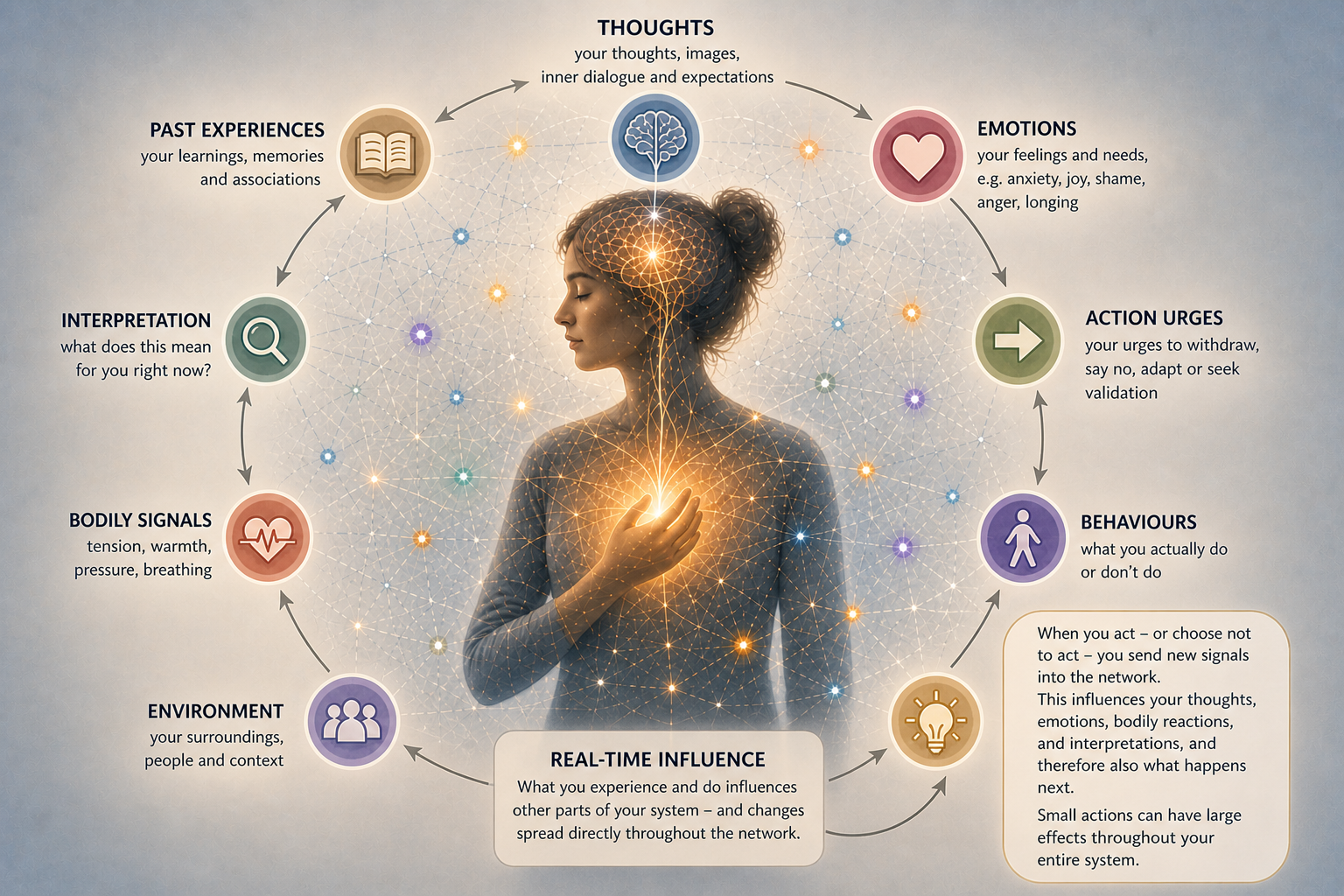
Figure 1: Psychological flexibility is about understanding the interaction between thoughts, emotions, the body’s signals, and our behaviours — and about creating more space between reaction and action.
When stress activation becomes a story
In relationships, this loop can make us start protecting ourselves against something that is not quite happening in the moment. Your partner is sitting with their phone during dinner and answers a little absent-mindedly while you are telling them something. The body registers distance, and the mind quickly fills in: “I am not important” or “there is no point trying to reach them.” If that story takes over, you may become cold, ironic, or withdraw for the rest of the evening. Perhaps you say nothing at all, but stop seeking contact. The consequence is that the distance actually increases, even though what you were really longing for was closeness, response, or a simple question: “Are you with me right now?”
Psychological flexibility is not about winning over the body. It is more helpful to create contact with what is happening, so that we do not have to act directly from the interpretation of what is going on. It may sound like this: “Right now I notice a strong impulse to say no to everything.” In another situation, the formulation may be: “Now my mind is trying to get complete certainty before I dare to choose.” Sometimes it is enough to note: “This feels urgent, but maybe I do not need to answer immediately.”
Such thoughts are not revolutionary, but they can create a small and important pause. Sometimes that pause is enough for another response to become possible.
A somatic perspective: the body carries learned behavioural patterns
To understand why we react the way we do, it is not enough to look at the situation here and now. The body carries learned patterns from previous experiences — patterns that influence how we react, interpret, and act in different contexts. From a somatic perspective, such as in Somatic Experiencing® developed by Dr. Peter A. Levine, an American psychologist and body-oriented trauma researcher based in the United States, the body is not just a place where we “have” emotions. It is an active part of how we orient ourselves in the world, with learned behavioural patterns for contact, protection, mobilisation, stillness, approach, and avoidance.
Some of these patterns have a history. They may have been helpful in previous contexts. Perhaps they involved quickly reading the mood in a room, holding things together, becoming strong and functional, saying yes even though something inside said no, or withdrawing before someone else had time to come close. They do not need to be described as wrong, but can be understood as adaptations. The body has learned something about how we get through the world. At the same time, old patterns can continue to be activated in new situations. What once helped us may later begin to limit our room for action.
In a workplace, this may mean that you take responsibility for the atmosphere in the room. A manager sounds stressed in the morning meeting, two colleagues become quiet after a discussion, and you immediately feel that you need to smooth things over. You joke away the tension, take on an extra task, or avoid saying that the timeline actually will not hold. In the short term, this may create calm. No one becomes irritated, the meeting moves on, and you may appear helpful. In the longer term, the consequence can be unclear boundaries, inner wear and tear, and a feeling that no one really sees what you are actually carrying. The workplace also gets less access to your honest assessment, because so much energy is spent regulating the room.
Somatic presence is therefore not about making the body relax. It begins with noticing what the body is already doing. Is there an impulse to tense up, hold your breath, lean away, become still, rush, explain, or adapt? Here we also need to be careful. In conversations about trauma, the body, and health, there are sometimes strong claims that can become simplified. Bodily reactions influence how we feel and how we perceive ourselves, but the body is not a simple answer key. Brain, body, relationships, environment, and life experiences interact.
Often, the most helpful thing is not to draw big conclusions, but to become curious about the pattern. What is happening in me right now? What is my system trying to protect me from? And what small choice would be possible if I did not have to act directly on the first impulse?
Sometimes this is exactly where psychological flexibility begins: in the possibility of allowing the body to signal, without letting it alone decide the direction.
Practising psychological flexibility without trying to fix yourself
Many people begin inner work because they want to get rid of or avoid something. Less anxiety, less stress, less self-criticism, or less bodily resistance. That longing is understandable. When something hurts, we want it to stop. At the same time, the very act of fixing can become yet another demand. We begin monitoring ourselves: Am I calm now? Have I understood enough? Should I have come further? Why am I still reacting like this? Then psychological flexibility risks becoming another ideal, something you have to perform. But psychological flexibility is not about always being open, calm, and wise. The ability also shows itself when we notice that we are not, without turning the reaction into a failure.
A simple starting point can be to pause and notice three things. First the body: what is actually noticeable right now, without it needing to be right or wrong? Then the mind: what story, rule, catastrophe, conclusion, or inner instruction is active? Finally, the direction: what matters here, beyond what would remove the discomfort most quickly? The answer may be yes. Sometimes it is no. Other times it leads to asking for time, setting a boundary, seeking support, staying a little longer, or leaving something that is not right.
In both private life and working life, this pause can be crucial. It can be the difference between saying yes out of fear and saying: “I need to think about that.” Between attacking and saying: “I notice I am becoming defensive right now.” Or between withdrawing and asking for contact in a more direct and understandable way. The point is not for the body to become silent. What matters is that you have more choices than simply reacting. Psychological flexibility is being able to listen without always obeying, feel without drowning, think without becoming trapped, and choose direction without first having to be completely free from fear, doubt, or resistance.
It is not a perfect stance. It is a practice in being human with more contact, more nuance, and a little more space. With psychological flexibility, the possibility increases of living more in the direction of the life you actually want to live.
• • •
Frequently Asked Questions about Psychological Flexibility
What does psychological flexibility mean?
Psychological flexibility means being able to be present with thoughts, emotions, and bodily reactions without automatically being driven by them. It also means being able to choose action in the direction of what matters, even when something feels difficult.
How does a lack of psychological flexibility show up in relationships?
It may show up through becoming defensive, saying yes even though the body says no, withdrawing, or beginning to avoid things that feel uncomfortable. Often, we interpret others through fear and previous experiences. The consequence is that contact decreases, even when what we actually need is clarity, closeness, or a more honest boundary.
Is psychological flexibility the same as being adaptable?
Not quite. Adaptability can sometimes mean going along with too much or shaping yourself around your surroundings. Psychological flexibility is more about being able to listen inwardly, see the situation more clearly, and choose action based on values rather than fear, demands, or familiar reaction patterns.
What does the body have to do with psychological flexibility?
The body is an active part of how we experience the world. Nervous system activation and bodily signals influence what feels safe, threatening, possible, or impossible. Through interoception — how we perceive the body from within — our experience in the moment is shaped. That is why psychological flexibility often begins with noticing the body’s response.
Is it the body or the brain that creates emotions?
It is more accurate to see emotions as something created through the interaction between brain, body, previous experiences, and context. The brain interprets the body’s signals and predicts what is happening, while the body is simultaneously affected by how the situation is understood.
Can psychological flexibility affect health?
Psychological flexibility is often linked to how we handle stress, relationships, recovery, and difficult situations. This does not mean that it cures illness or guarantees physical health, but it can influence how we meet strain, recover, and take care of our needs.
What does avoidance mean in this context?
Avoidance means trying to reduce discomfort in the short term, for example by saying yes even though you want to say no, postponing something, or withdrawing. It can bring relief in the moment, but in the longer term it can move you away from what matters and reduce your room for action.
Why does it feel as though I get stuck in the same patterns?
When bodily reactions, thoughts, and previous experiences work together, they can reinforce each other. This can create a sense that the reaction is obvious or necessary, even when it is not helpful. Psychological flexibility is about beginning to notice that process, so that new choices become possible.
How can I begin practising psychological flexibility in everyday life?
One simple way is to pause and notice three things: the body — what is happening right now? The mind — what thoughts or stories are active? And the direction — what matters here? This creates a small space between impulse and action, where you can choose how you want to act.

Figure 2: Psychological flexibility can begin with a simple pause: noticing the body, the thoughts, and which direction feels important before we act.